
Domino 101
Get up to speed with the basics in this guide.
Learn the basics
The highlight on the right is interactive. Try it out!
Tiles, bones, and pips Read the marks on a domino.
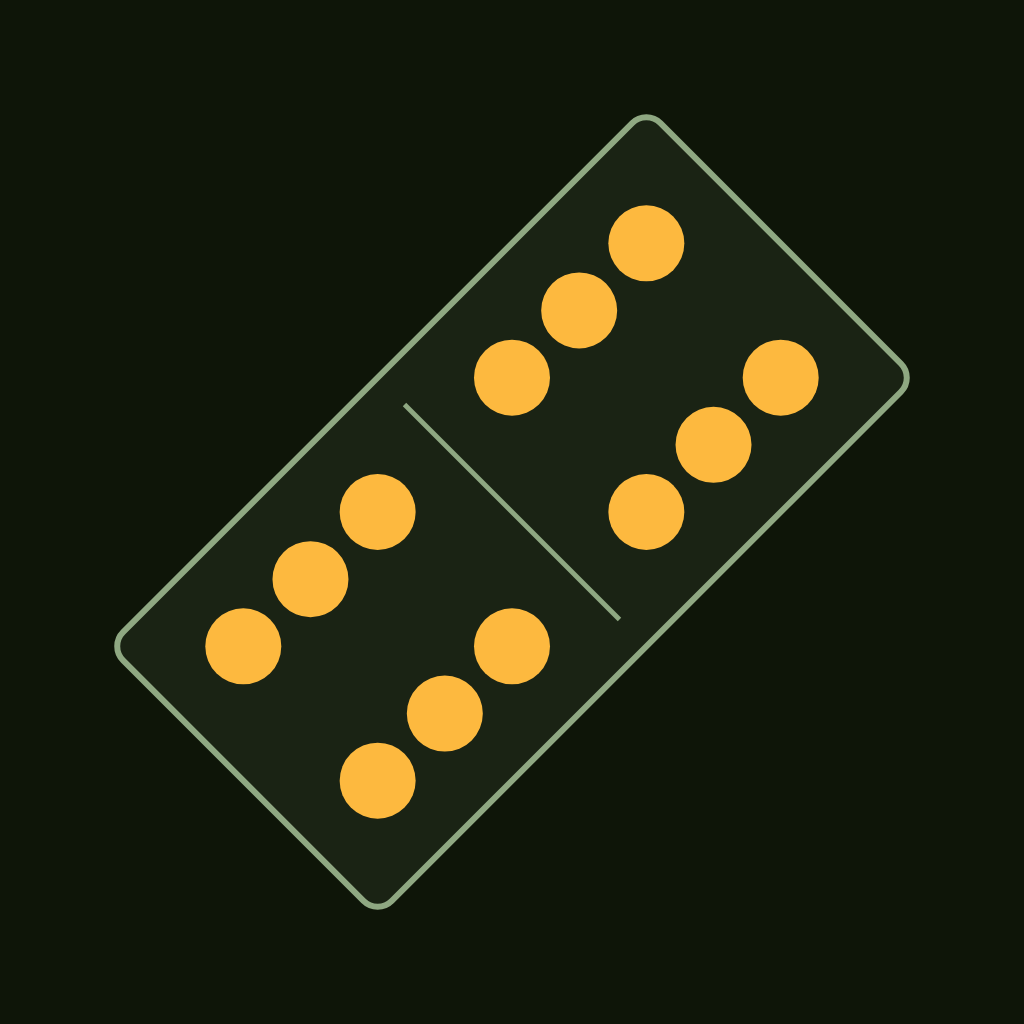
A domino tile, also called a bone, has two ends. Each half shows dots called pips, with values from zero through six.
Zero is usually called blank. You may also hear one called ace, two called deuce, and three called trey.
Add both halves to get the value of a domino. Three plus five gives this tile a pip value of eight.
The double-six set Every pair from blank through six.
A standard double-six set has 28 dominoes, containing every combination from through . Each number appears on exactly seven dominoes.
A double is a domino with the same value on both halves, such as . There are seven doubles—one for each value from blank through six.
The pose Place the first domino in the chain.
The first domino played is usually called the pose. It normally goes in the centre and starts the domino chain.
The tile that may be played first depends on the game variant. In the Basics lesson, double six is the required pose.
- Find in the lesson hand.
- Play it in the centre as the pose.
- Use its sixes as the first matching values for the chain.
Match the chain Touch equal values at the open ends.
Most domino games create chains by placing tiles so that touching ends have matching values. Doubles are usually placed perpendicular to the chain.
In the lesson’s final move, the open end shows three. Play with its three touching that open three.
Learn the gametypes
Now you know the basics, click to learn how to play the other variant.s